Start a Boxing Center business

 The earliest known depiction of boxing comes from a Sumerian relief from the 3rd millennium BC.Later depictions from the 2nd millennium BC are found in reliefs from the Mesopotamian nations of Assyria and Babylonia, and in Hittite art from Asia Minor. The earliest evidence for fist fighting with any kind of gloves can be found onMinoan Crete (c. 1500–900 BC), and on Sardinia, if we consider the boxing statuesof Prama mountains (c. 2000–1000 BC).
 A boxer's training depends largely on the point in their career at which he or she is situated. If the boxer is just a beginner, a minimal training routine might consist of learning how to hit the heavy bag, the speed bag, and the double end bag (a small bag with a cord on top and bottom connecting it to the floor and ceiling) as well as doing shadowboxing in front of a mirror, skipping rope, calisthenics and jogging every day, as well as an occasional practice bout inside the ring (sparring). Most beginning boxers will spend most of their early careers conditioning and establishing the fundamentals. For the amateur or professional boxer preparing for a competition or bout, however, training is much more stringent. Boxing is widely considered one of the most physically demanding sports in the world.
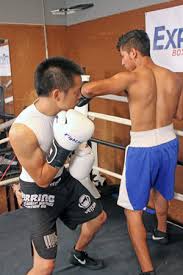 It’s easy to throw a single lead hook and even a double. However, very few fighters can effectively throw the lead hook in threes, fours and even more.


Business Overview
Market Research Report

Introduction:-
Boxing clubs are
expensive to start. However, many businesses combine fitness and boxing to
broaden their client base and attract more income. A mutually beneficial spiral
frequently develops where fitness income covers the expenses of the facility
and equipment, while boxing successes attract more fitness clients. Currently
there are also a number of fitness programs that have been created that combine
boxing and fitness into hybrids, such as kickboxing exercise classes.
Planning Phase
Step 1
Take time to develop a professional and realistic business
plan for your club. Contact your local business promotion organizations, such
as the Chamber of Commerce, for information regarding local demographics,
related businesses that might be competition and details regarding the local
economy. Imagine a typical working week for your club and identify all expenses
incurred. Although it may be tempting to inflate potential income figures and
deflate expected costs, the more accurate your business plan is, the higher the
chance that your business will succeed.
Step 2
Contact your local bank or the Small Business Administration
in your area. If they do not have the funding you need, the people there may be
able to put you in contact with other funding sources that do. Determine the
minimum amount of money needed to run your boxing and fitness club for the
first 6 months. Don't count on being able to cut corners or save on expenses,
plan for the need to cover the full amount.
Step 3
Contact the boxing regulatory agencies in your area to
determine what kinds of permits or licenses you will need so your fighters can
participate in competition. Speak with county or city treasurer's office
personnel to determine what business licenses you need to secure. Investigate local
fitness club requirements to make sure you are in compliance with health and
sanitation laws. Find out whether the various permits or licenses need to be
publicly displayed and be prepared for inspectors to drop by to see that you
are in compliance.
Start up Phase
Step 1
Remember the old adage, location, location, location. Think
about how far your typical client would be willing to travel to your facility
and select a building that is easily accessible to your largest client group.
Although a few intensely dedicated clients may not care about looks, pick a
location that is visually appealing to the more typical hobbyist, whose greater
numbers usually make up the bulk of boxing fitness club members.
Step 2
List the minimum amount of training equipment you will need
to start your club and also create a wish list of extras that you would like to
have. Check around for used equipment if keeping costs down is a factor. Apply
a new coat of paint or new labels to give new life to equipment you might be
able to purchase inexpensively from another club. Always make safety your top
consideration with equipment.
Step 3
Remember that the heart of your business will be your staff.
Hire the best people you can afford and pay them as well as possible. Many
coaches and trainers have developed their own following, which could
potentially create an automatic client base for your new club. Observe your
staff at work and listen carefully to client comments to refine what is working
for your location and style
History
Early history
Boxing was a popular spectator sport in Ancient Rome. In order for the fighters to protect themselves against their opponents they wrapped leather thongs around their fists. Eventually harder leather was used and the thong soon became aweapon. The Romans even introduced metal studs to the thongs to make the cestuswhich then led to a more sinister weapon called the myrmex (‘limb piercer’). Fighting events were held at Roman Amphitheatres. The Roman form of boxing was often a fight until death to please the spectators who gathered at such events. However, especially in later times, purchased slaves and trained combat performers were valuable commodities, and their lives were not given up without due consideration. Often slaves were used against one another in a circle marked on the floor. This is where the term ring came from. In 393 AD, during the Roman gladiator period, boxing was abolished due to excessive brutality. It was not until the late 17th century that boxing re-surfaced in London.
Training
 A boxer's training depends largely on the point in their career at which he or she is situated. If the boxer is just a beginner, a minimal training routine might consist of learning how to hit the heavy bag, the speed bag, and the double end bag (a small bag with a cord on top and bottom connecting it to the floor and ceiling) as well as doing shadowboxing in front of a mirror, skipping rope, calisthenics and jogging every day, as well as an occasional practice bout inside the ring (sparring). Most beginning boxers will spend most of their early careers conditioning and establishing the fundamentals. For the amateur or professional boxer preparing for a competition or bout, however, training is much more stringent. Boxing is widely considered one of the most physically demanding sports in the world.
Weight
Boxing, like several other fighting sports, categorizes its competitors into weight classes. Some fighters try to take advantage of this by dieting before weigh-in so that they can be bumped down a weight class. In extreme cases, a fighter may forego solid food before the official weigh-in ceremony, and eat a lot afterward to compensate. In some very extreme cases, boxers have been forced to stop eating solid food up to three days before the weigh-in ceremony, in order to make weight for the fight. Sometimes, if a boxer doesn't make the weight agreed for on the first weight-in, he or she might go to a sauna or to jog with a jacket to sweat and lose the extra pounds, however this is mainly water that the body holds. After weigh ins, competitors will general add on weight before the fight, resulting in them weighing anywhere from 5 to 25 lbs above the weight class.A boxer will generally try to have the maximum weight possible within the Boxing weight classes (s)he is fighting in, as a good boxer will be able to use his weight to his advantage.
Advanced Boxing Techniques
BOXING TECHNIQUES
Boxing techniques, boxing advice, and boxing instructions to help all boxers train and perfect their boxing skills to become a stronger, more powerful, and faster boxer. Great technique should improve effectiveness and efficiency. Great fighting techniques are focused on improving performance as opposed to be limited by rules and forms. Every fighter and fighting situation is different requiring mastery of many techniques. There are no such things as the "best fighting techniques", there are only good applications. Technique in itself is not so much what you do, but how you use it.
1) Corkscrew Punch

The corkscrew punch is a punch that is thrown while twisting the shoulder, elbow and wrist all in one motion, so that your thumb ends up facing downwards and your palm facing the outside. For some fighters, this technique can be awkward and many choose to avoid using it. The benefits of this punch includes:
§ Hand Protection: Your forearms add more stability in the wrist by placing it sideways. Many fighters injure their thumbs when throwing power punches, but when you corkscrew a punch, you ensure that your knuckles (particularly on the forefinger) come in contact with the target first without your thumb feeling any impact.
§ Chin Protection: You’ll find that when you corkscrew a punch, the shoulder of your punching arm automatically raises slightly resulting in better protection for your chin.
§ Better Defensive Posture: The motion of a corkscrew punch forces you to lean at an angle where it’s more difficult for your opponent to catch you with a counterpunch.
There are certain punches that work well with the corkscrew boxing technique while others I don’t recommend. I would avoid using the corkscrew jab because it doesn’t leave you in a good position to follow up with any other punches and also uppercuts tend to be very awkward to corkscrew.
I would recommend the following corkscrew punches:
§ Corkscrew Cross: The cross is easiest punch to throw with a corkscrew motion and it’s a power punch that will hit the target quicker than any other power punch.
§ Corkscrew Lead Hook: The lead hook is one of the most effective punches in general, but you may want to consider using a corkscrew motion if you find that you hurt your wrist or thumb when you throw the hook.
§ Corkscrew Rear Hook: The rear hook is thrown from the back and therefore, it can often be difficult connecting the knuckles to the target when throwing it conventionally, especially if your opponent is only just within your reach or at a hard-to-connect angle. By corkscrewing the rear hook, you can hit the target with your knuckles much easier without damaging your wrist as you will have more support from your forearm.
§ Corkscrew Overhand: This is my favorite corkscrew punch. It’s the same as the corkscrew rear hook but comes from an above angle opposed to the side, therefore making it more difficult for your opponent to see.
2) Leaping Lead Hook


Although it sounds relatively simple, the leaping lead hook, which is literally just a lead hook thrown while jumping in at the time same, is a difficult punch to master.
There are many factors involved that makes up a beautifully thrown leaping lead hook. These include foot movement, body positioning, accuracy, timing and of course, the technique of the punch itself.
Failure to effectively implement any of the aforementioned elements can result in you leaping into a counterpunch instead.
Here are some tips for effectively throwing the leaping lead hook:
§ Measure Distance: Never leap in from too far out because your opponent will be able to see it coming. You’re supposed to throw it when you’re just out of range by a few inches.
§ Jump Height: When you leap in, the maximum height your feet should leave the ground is only by around an inch. In fact, as you leap in, ideally your feet should sweep the floor as if you’re gliding.
§ Bend Your Knees: From the moment you leap and when you land, your knees should be slightly bent. This ensures stability and a quick escape should you miss.
§ Keep It Short: Don’t throw the lead hook too wide because you’ll reduce speed and power. If you’re within the correct distance, then you’ll be able to throw a short lead hook that is both quick and powerful.
§ Control Your Power: Don’t follow through with the hook because if you miss, you’ll end up swinging wildly off-balance.
§ Keep Your Guard Up: This goes without saying, keep your rear guard held high covering your chin.
If you not very experienced or athletic, then you should avoid using the leaping lead hook because it’s risky and can easily go wrong.
3) Multiple Lead Hook
Here are some tips for throwing multiple lead hooks successfully:
§ Throw Quick: When you throw more than two of the same punch, it’s all about speed.
§ Throw Short: In order to throw quick punches in threes and fours, they must be kept short which means that you must be in close range.
§ Target Upstairs: Aim for the face and not the body because going for the body with multiple weak punches is ineffective and will just leave you open for a counter. You can however, go to the body for your last hook since it will be your most powerful.
§ Control Your Power: Only the last punch of the combination should be thrown with power. All previous punches of the combination should have minimal power to serve as a distraction.
4) Double Cross
The double cross / straight, holds the same principles as the multiple lead hook, except that the double cross is more effective and less risky. To pull it off successfully, just follow these steps:
1. Throw a cross punch as normal but without following through. This helps to blind your opponent’s vision.
2. As it hits the target, pull your arm back slightly, only by a few inches.
3. Extend your arm again to hit the target again.
All of this should be done very quickly. The double cross will distract and frustrate your opponent and if done correctly, it’s also great for setting up a hard body shot.
5) Shoulder Roll
The shoulder roll technique is a is a defensive maneuver made popular by Floyd Mayweather Jr, James Toney and more recently, Adrien Broner. It involves using the lead shoulder to deflect the cross and overhand, and the forearm to protect the body. Once the punch is deflected, it then leaves you in an excellent position to throw a short counter uppercut / cross.
The shoulder roll requires good reflexes, timing and body positioning. Even the slightest error of judgement can lead to getting hit flush, since your lead arm is held low.
Not many fighters can pull it off successfully (often due to style and technique) and I wouldn’t recommend that you try it without an great amount of practice first. It’s not for everyone and if the shoulder roll doesn’t suit your style, then just leave it out altogether, otherwise you can end up completely messing it up.
Business Overview
Once a sport for the brutes, boxing and kickboxing is quickly
becoming one of the most popular fitness activities in North America enjoyed by
millions of participants regardless of age or gender. An interest in the sport
of boxing or kickboxing is definitely a prerequisite for starting a boxing
center. However, a great deal of boxing experience or training is not, simply
due to the fact that you can hire certified boxing and kickboxing instructors
to conduct classes and oversee the general operation of the business. You can
also add fun and fitness classes to the roster, such as aerobic boxing and
kickboxing, self-defense boxing training, and monthly amateur boxing and
kickboxing tournaments. In total, approximately 4,000 to 6,000 square feet of
space will be required to operate the business, and equipment purchases will be
expensive, making this a business venture that'll require careful planning and
research.
Market Research Report
Your customers will range from the fitness buff looking for a fun
aerobic activity to more serious boxers looking to improve their skills. Build
a membership base quickly by distributing two-for-one coupons that entitle the
bearer the opportunity to join the boxing center for one month and receive the second month of membership
free of charge.
For more details:-
http://www.livestrong.com/article/514128-how-to-open-an-amateur-boxing-club-or-boxing-gym/


